Emergency Food for Australian Families:
The ReadyWise 25-Year Bucket, Reviewed
Freeze-dried survival food is the one category where the Australian buyer pays roughly double and hears almost nothing written for this market. This is where ReadyWise fits, where it does not, and what the same money buys at Woolworths instead.
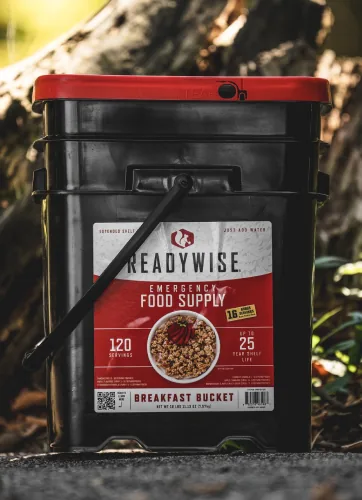
It is a US emergency food brand shipping domestically and internationally (AU, UK, CA). Their flagship 120-serving bucket costs USD $329.99 — roughly AUD $510 / GBP £260 / CAD $455 for international buyers. US customers can find it discounted to as low as USD $74 at Walmart flash sales. The food is real: freeze-dried with a genuine 25-year shelf life, prepared by just adding boiling water. The main caveat is serving size — "120 servings" are small portions, so plan for 3–4 days for a family of four per bucket. Rated 7.8/10. Best for: US families in hurricane/tornado zones, and Australian or UK families in flood or bushfire risk areas who want set-and-forget food security.
📋 Quick Verdict — Emergency Food Bucket (2026)
📦 Product at a Glance
| Category | Emergency Food Supply |
| Format | Physical bucket — 120 servings, 25-year shelf life |
| Best For | Flood/bushfire-prone families |
| 120-Serving Price | USD $329.99 (~AUD $510) |
| Guarantee | 60-day money-back |
| Our Rating | 7.8/10 |
What Sends Families Looking at Emergency Food Storage
After our second flood event in three years (regional NSW — we're in a flood corridor), I sat down and properly assessed what our family could actually survive on if we were cut off for two weeks. The honest answer was: about four days. We had pasta, tinned tomatoes, some canned beans, and whatever was in the freezer, which becomes useless after 12 hours without power.
What I wanted was food that didn't require refrigeration, didn't need to be rotated every 12 months, and could feed a family of four without requiring a working stovetop. That pointed me toward freeze-dried emergency food, and this brand kept coming up in my research as one of the more reputable brands with actual Australian distribution.
"Two weeks cut off from the supermarket was the scenario I was planning for. Most of our pantry would last four days — five if we rationed. That wasn't good enough."
One thing to be upfront about: this review is built from the product documentation, the nutrition panels, the pricing across four markets and what buyers report after opening the pouches. Nobody here has eaten their way through a bucket, and a reviewer who claims to have lived on emergency rations for a fortnight to test them is telling you a story.
What ReadyWise Actually Is
ReadyWise, which traded as Wise Company until the rebrand and still turns up in searches under the old name, is a US emergency food brand operating since around 2008. If you have seen "Wise Food" buckets referenced in an older forum thread, that is this company. They specialise in freeze-dried and dehydrated meals packaged in individual pouches that are then stored in stackable plastic buckets. The buckets have grab-and-go handles for quick evacuation, and the individual Metallyte pouches are designed to protect food from moisture and oxygen — hence the 25-year shelf life claim.
Their product range covers everything from entry-level 14-day buckets to full one-year emergency food supplies. The most popular product for families getting started is the 120 Serving Emergency Food Supply — one bucket containing 11 different meal types across breakfast, lunch, and dinner, with a total of 24,540 calories (13 days at 1,800 cal/day).
What You Get: The 120-Serving Bucket Breakdown
| Meal | Pouches | Servings | Notes |
|---|---|---|---|
| Cheesy Lasagna | 2 | 12 | Included |
| Creamy Pasta & Vegetables | 2 | 12 | Included |
| Savory Stroganoff | 2 | 12 | Included |
| Cheesy Macaroni | 2 | 12 | Included |
| Pasta Alfredo | 2 | 12 | Included |
| Gluten Free Teriyaki Rice | 2 | 12 | GF option |
| Tomato Basil Soup with Pasta | 1 | 6 | Included |
| Hearty Tortilla Soup | 2 | 12 | Included |
| Chicken Flavoured Noodle Soup | 1 | 6 | Included |
| GF Potatoes & Chicken Pot Pie | 1 | 6 | GF option |
| Southwest Rice and Beans | 3 | 18 | Included |
| Total | 20 pouches | 120 servings | 24,540 cal total |
Price by Country: AU, US, UK and Canada
This is a US brand, which means pricing and availability varies significantly by country. Their flagship 120-serving bucket is priced at USD $329.99 on the official site, but US buyers have the best deal by far, with access to retailers like Walmart, Amazon, and Costco that regularly discount the range. At current exchange rates, the international picture looks like this:
| Currency | Approx. Price | Notes |
|---|---|---|
| 🇺🇸 USD | $329.99 | Best value — also available at Walmart, Amazon, Costco at discount |
| 🇦🇺 AUD | ~$510 | Plus international shipping — check local AU stockists first |
| 🇬🇧 GBP | ~£260 | Plus international shipping |
| 🇨🇦 CAD | ~$455 | Plus international shipping |
For international buyers outside the US, the price premium is real. Australians and Canadians pay roughly 35–55% more once shipping is factored in. This is worth knowing going in, but for many families in high-risk areas, the 25-year shelf life still makes the math work.
How the Food Actually Tastes
To be clear: this is emergency food, not restaurant food, the goal is keeping hungry, irritable kids fed during a genuine emergency, not fine dining. User reviews of the Cheesy Lasagna and Southwest Rice and Beans varieties describe them as functional — edible and satisfying, the kind of thing you'd eat again if the alternative was nothing, but not something people reach for out of enjoyment. Across aggregated buyer reviews on the seller's own site and third-party retailers, the most consistent theme is that flavour and texture are secondary to reliability — reviewers overwhelmingly rate the product on shelf life and ease of preparation rather than taste. For exact sodium, calorie and allergen figures per serving, check the nutrition panel on the current product listing, as formulations are occasionally updated.
Two varieties come up more than the others in buyer comments. The Cheesy Lasagna is repeatedly described as mild and a little starchy, with pasta flavour that does the job and no more. Southwest Rice and Beans draws better notes: seasoned properly, filling, with beans that hold their texture. Both are prepared the same way, boiling water into the pouch, stirred, resealed, fifteen minutes.
"This is food you'll be glad you have. It's not food you'll be glad you're eating. That's a fair distinction for emergency rations."
Placed against the rest of the category, that is a reasonable showing. Compressed ration bars are reliably described as grim, generic supermarket ration packs worse again, and home vacuum-sealed pantry food better than both while demanding far more planning. It sits above the basic end and is unusually honest about what it is.
Can you buy ReadyWise at Costco in Australia?
This is one of the most-searched questions attached to the brand here, and the answer is not the one the search results imply.
ReadyWise does appear on Costco shelves and on Costco's website in the United States, often at a sharp discount, which is where nearly every "ReadyWise Costco" result online comes from. Australian Costco warehouses are a different buying operation with a different range. Emergency food buckets are not a standing line here, and when preparedness stock does appear in an Australian warehouse it tends to be seasonal, limited, and gone quickly.
The practical consequence for an Australian buyer: the Costco price you found in a US review is not a price you can act on. What is available here is direct ordering with international shipping, which is exactly why the Australian landed cost sits so far above the American shelf price. If a local listing does turn up, check the serving count on the bucket before comparing anything, because the 60, 120 and 150-serving buckets are frequently confused with each other.
Which bucket size actually suits a household?
The range is easy to get wrong, because the numbers on the front describe servings rather than meals, and the servings are small.
| Bucket | Stated servings | Realistic for a family of four | Best use |
|---|---|---|---|
| 60-serving | 60 | Around 2 days | A first bucket, or a car and evacuation kit |
| 120-serving | 120 | Around 3–4 days | The default starting point for most households |
| 150-serving | 150 | Around 4–5 days | Better cost per calorie if you have already decided |
| Entrée / meat buckets | Varies | Supplementary | Adding protein variety to a carb-heavy base |
The pattern worth copying is not buying one enormous bucket. It is buying the size that covers the gap you actually have, then adding an entrée or meat bucket later if the standard range looks too heavy on pasta, which it is.
There is also a smaller grab-bag format built around evacuation rather than storage. If the scenario you are planning for is leaving the house in twenty minutes rather than sitting it out, that is the one to look at first.
Pros and Cons
✓ What Works
- Genuine 25-year shelf life, no annual rotation
- Just-add-water preparation — works on a camping stove
- Stackable buckets with grab-and-go handles
- Some gluten-free options included
- Ships internationally including AU, UK, CA
- Proven brand — operating since ~2008
- 24,540 calories per bucket — solid caloric density
✗ What Doesn't
- Price is steep for non-US buyers (AUD ~$510+)
- Serving sizes are small — plan for 2–3x the stated servings
- Taste is functional, not enjoyable
- Heavy on pasta/carbs, low on protein variety
- No fresh or freeze-dried meat in the standard bucket
- Requires boiling water — needs a heat source
- Australian buyers pay international shipping on top
Who This Is For — and Who It Isn't
| Scenario | Verdict |
|---|---|
| Families in flood, cyclone, or bushfire zones who want set-and-forget food storage | ✓ Strong fit |
| US families in hurricane belt (Florida, Gulf Coast), tornado alley, or wildfire zones (CA, OR, WA) | ✓ Strong fit — best price + domestic shipping |
| Anyone who's been caught out in a major blackout with empty shelves and spoiled food | ✓ Strong fit |
| Regional and rural Australians where road access can be cut for days | ✓ Strong fit |
| Canadian families in BC wildfire zones, Alberta flood plains, or Ontario ice storm corridors | ✓ Strong fit — road closures and power outages can last weeks |
| Families on a tight budget looking for the most economical emergency food option | ✗ Not the right fit — DIY pantry is cheaper |
| People with complex dietary needs (low-sodium, allergies, vegan) | ✗ Limited options — some GF, but not designed for this |
| Someone wanting emergency food that also tastes good day-to-day | ✗ Not the right fit — this is emergency food, not everyday food |
| Families who already have a solid 7-day pantry and want to extend to 30 days | ✓ Solid fit — use this for the extension |
How It Compares to Stocking a Deep Pantry
The honest alternative to ReadyWise, and what most Australians default to, is building a deep pantry from supermarket staples: rice, pasta, canned legumes, canned fish, long-life milk, oats, and cooking oil. This approach is significantly cheaper per calorie and produces food that generally tastes better.
The limitations of that approach are real, though:
- Rotation required: Most supermarket staples last 1–3 years. You need to actively rotate stock or waste money and food.
- Storage space: Cans and dry goods require significant pantry space, not available in every home.
- Preparation complexity: Cooking dried beans and pasta requires water, fuel, and time. During a major emergency, all three may be limited.
- Not grab-and-go: If you need to evacuate quickly, a deep pantry doesn't fit in your car. A sealed bucket does.
My recommendation for most Australian families: build both. A well-stocked pantry for the majority of scenarios, with one or two sealed buckets as the long-term set-and-forget backup and evacuation option.
Pricing and Where to Buy
120-Serving Emergency Food Bucket
Ready to Start Your Emergency Food Supply?
If you've been putting off building a proper food store, a ReadyWise bucket is one of the easiest first steps, no rotation, no planning, just store and forget until you need it.
View ReadyWise Emergency Food →Frequently Asked Questions
My Final Verdict
ReadyWise is not perfect, the price is real money for non-US buyers, the serving sizes are optimistic, and the food won't win any awards. But it does exactly what it's designed to do: provide long-lasting, simple-to-prepare emergency food that requires no maintenance and no thought for 25 years.
For Australian families who've lived through blackouts, floods, or bushfires and found their food situation inadequate, ReadyWise fills a gap that a DIY pantry doesn't fully cover. The pattern owners describe most often is two buckets held back as the untouchable layer behind a rotating pantry, and I sleep a bit better knowing they're there.
If you're comparing options — see our full comparison of the best emergency preparedness products for Australian families.
Not professional advice: Erin Delaney is a family preparedness enthusiast, not a nutritionist or emergency management professional. Always follow official emergency guidance from your local government for disaster preparedness.